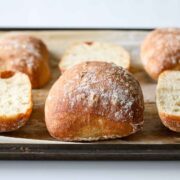
Sourdough Ciabatta Bread Rolls Recipe
Rustic, chewy, and flavorful with a beautiful open crumb, sourdough ciabatta is just as perfect for dipping into your favorite olive oil as it is for building your dream sandwich.
Servings: 8 Ciabattas
Calories: 226kcal
Equipment
- 1 Sheet pan
- Parchment paper
Ingredients
- 110 g active starter
- 380 g water for US measurements, consider 1 ½ cups plus 1 ½ tbsps of water
- 12 g salt
- 500 g bread flour
Instructions
- Start by mixing the active starter, water, and bread flour.
- Do a 30-minute fermentolyze, then add the salt just before the first stretch and fold. This helps develop gluten, making the dough easier to handle later.
- After the fermentolyze, do 5 sets of stretches and folds, spaced 30 to 45 minutes apart. The dough will gradually become less sticky, more elastic, and smoother.
- After the last stretch and fold, transfer the dough to a rectangular container (about 9x13 inches). Let it bulk ferment until it’s jiggly and feels light. If you pull it from the container, it should come out without much resistance and no “cobwebs”.
- When bulk fermentation is done, flour the top of the dough and a clean work surface. Turn the container upside down and let the dough gently fall onto the floured surface. Handle it as little as possible to preserve the air bubbles developed during fermentation.
- Once the dough is on the counter, only stretch it if necessary. If it already has a decent rectangular shape, flour the top (which was the bottom during fermentation), and use a bench knife to divide the dough into 6 or 8 portions. Press the knife down and shake gently until the dough tears completely beneath it. If you’re unsure, watch the video to see how I do it.
- Line a sheet pan with parchment paper, flour it lightly, and gently transfer each ciabatta onto it, spacing them 1 to 2 inches apart so they don’t touch when baking. Let them proof for at least one more hour, or until they’re jiggly, airy-looking, and soft. This might take longer on cold days. In summer, or if your dough was fully proofed when divided, keep a close eye.
- Bake the ciabattas in a preheated oven at 450°F/230°C for 25 minutes, or until golden brown on top. Let them cool for 10 minutes before serving.
Video
Notes
This is a high-hydration dough, so expect it to be stickier than your regular sourdough. In Wet your hands slightly if you’re having trouble when stretching and folding.
If my kitchen is between 72°F/22°C and 74°F/23°C, total bulk fermentation time (which starts as soon as the dough is mixed) is about 7–10 hours. If I’m cold-proofing to bake the next day, I let it rise to no more than 85% of its size before placing the dough in the fridge.
Nutrition
Serving: 1ciabatta | Calories: 226kcal | Carbohydrates: 45g | Protein: 7g | Fat: 1g | Saturated Fat: 0.2g | Polyunsaturated Fat: 0.5g | Monounsaturated Fat: 0.1g | Sodium: 585mg | Potassium: 63mg | Fiber: 2g | Sugar: 0.2g | Vitamin A: 1IU | Calcium: 11mg | Iron: 1mg
